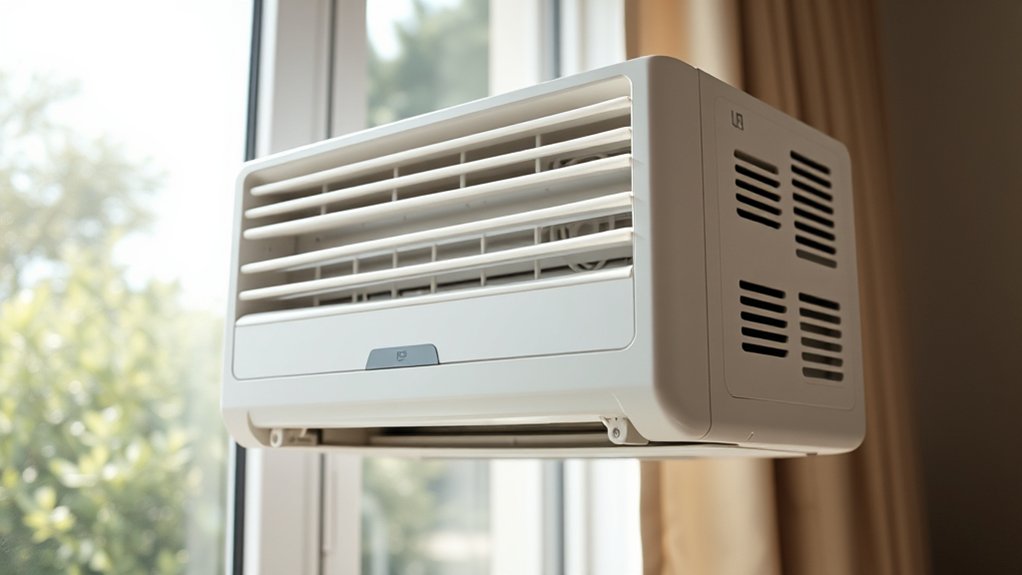
10 Tips to Choose the Right Size for Your Window AC Unit
If you’re tired of sweating through the hottest days without the perfect window AC unit, you’re not alone. Many people struggle with finding the right size to keep their space cool without wasting energy or making noise. Choosing the right window AC is key, and it can feel overwhelming with so many options out there.
To choose the right window AC size, start by accurately measuring your room’s dimensions and calculating its square footage. Consider how insulation, sunlight exposure, and room layout affect cooling needs, as these factors influence the BTU rating required.
Make sure the unit isn’t too small or large to avoid inefficiency and noise issues. Comparing models based on features and energy efficiency helps you find the best fit. Keep in mind proper installation and potential room changes—this guide will help you master each step.
Key Takeaways
- Measure your room’s length, width, and height accurately to figure out the right cooling capacity in BTUs.
- Calculate the room’s square footage so you can pick an AC unit with the appropriate cooling power for your space.
- Think about insulation quality and sunlight exposure, and adjust the BTU rating accordingly.
- Avoid choosing an AC that’s too big or too small by matching the unit to your room’s size and layout for the best efficiency.
- Check the unit’s BTU rating against your room’s specific needs to make sure it cools effectively without wasting energy.
How to Determine the Right AC Cooling Capacity for Your Room
To choose the right AC cooling capacity for your room, start by calculating its size and heat load. This helps ensure your unit isn’t too powerful or too weak, which is key for energy efficiency and comfort.
An undersized unit will struggle to cool the space, leading to higher energy use and more noise from overworking. On the other hand, an oversized unit cools quickly but turns on and off often, wasting energy and causing uneven temperatures.
To find the right capacity, measure your room’s square footage. Then think about factors like sunlight exposure, insulation, and how many people usually occupy the space.
A properly sized unit not only cools effectively but also saves you money on electricity. Pay attention to noise levels too; a loud unit can disrupt your peace, especially in bedrooms or quiet work areas.
Choosing the right capacity means you get effective cooling without sacrificing comfort or efficiency.
Why Room Size and Layout Matter When Choosing a Window AC
Your room’s size and layout directly influence which window AC will work best. Larger rooms need a unit with higher cooling capacity, while smaller spaces require less power to avoid overcooling.
The layout affects how effectively the cool air circulates. For example, a room with multiple windows or unusual shapes may need strategic window placement to maximize airflow. Proper placement helps ensure optimal cooling and reduces energy waste.
The room’s layout also impacts noise levels. A larger space can often absorb sound better, but if the AC is too powerful, it may create unnecessary noise. In small or tightly packed rooms, a louder unit can be disruptive.
Thinking about both room size and layout helps you choose an AC that cools efficiently without excessive noise. This way, you’ll get comfort and quiet operation. Tailoring your choice to these factors makes sure your window AC performs well and fits your space perfectly.
What Do BTU Ratings Tell You About Your Air Conditioner?
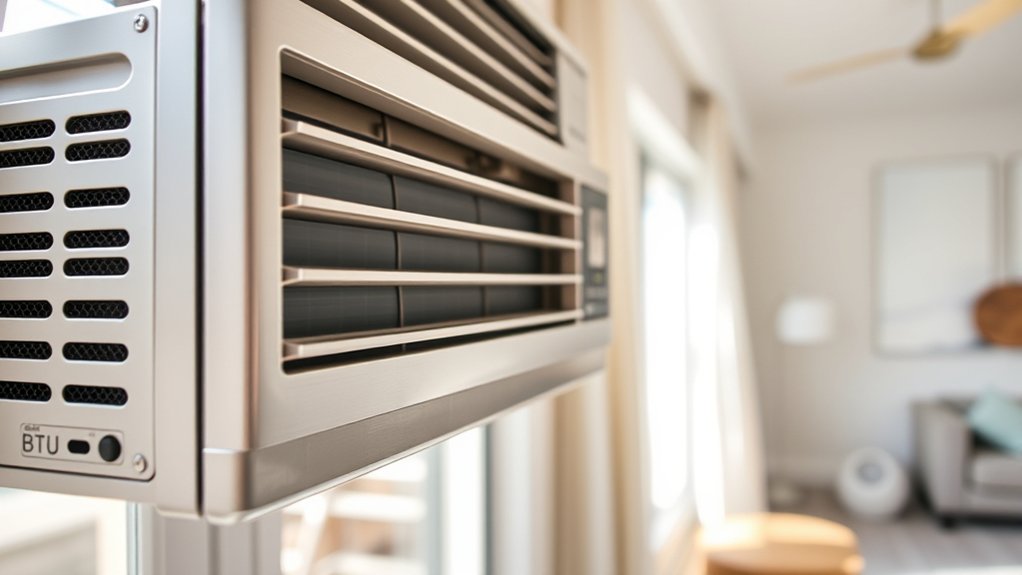
BTU ratings, or British Thermal Units, show how much heat an air conditioner can remove from a room per hour. The higher the BTU, the more cooling power it has, helping you pick a unit that fits your room’s size.
But it’s not just about cooling capacity. You should also think about energy efficiency. A properly sized AC with the right BTU will use less energy, saving you money and helping the environment.
Noise levels can also vary with different BTU ratings. Larger units tend to be noisier, so if quiet operation matters, choose one with an appropriate BTU for your space.
How to Calculate Your Room’s Cooling Needs Accurately
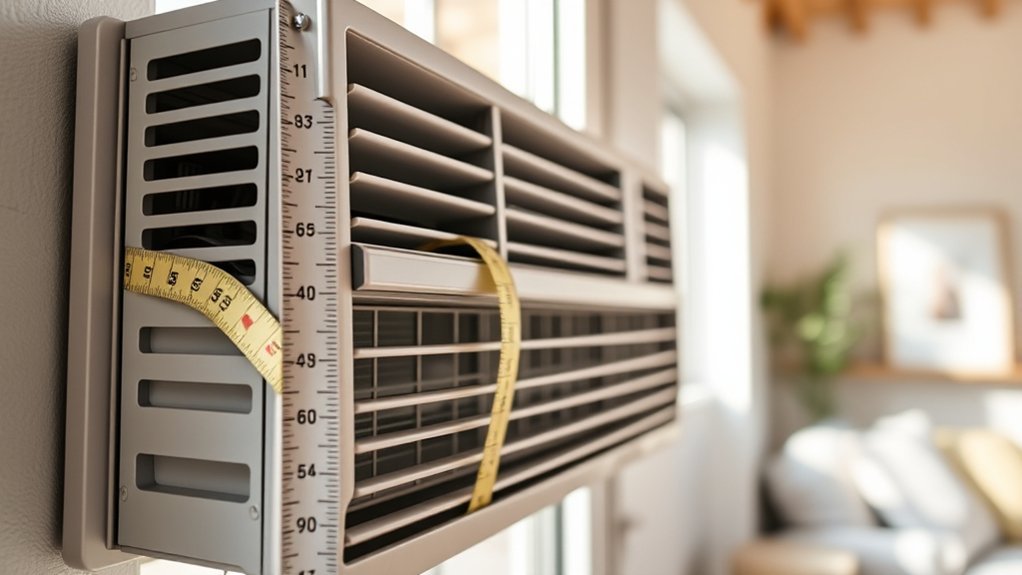
To figure out how much cooling your room actually needs, start by measuring the size of the space carefully—grab a tape measure and jot down the length, width, and height. It might sound simple, but these measurements are the first step toward choosing the right air conditioner.
Keep in mind that things like insulation and sunlight can really influence how much cooling power you’ll need. If your room gets a lot of sun or isn’t well insulated, you might need a slightly more powerful unit. So, be sure to adjust your calculations to match these factors. That way, you’ll end up with an AC that’s just right—not too big and not too small.
Measure Room Dimensions Precisely
Accurately measuring your room’s dimensions is key to choosing the right size of your window AC unit. Start by measuring the length, width, and height of each room.
Use a tape measure for precise numbers, and write down every measurement. Proper window placement can affect cooling efficiency, so consider the room’s shape and layout when measuring.
Keep in mind that larger rooms need more cooling power, while smaller spaces require less. Don’t forget to think about noise levels; a unit that’s too powerful might be louder and less comfortable.
Consider Insulation and Sunlight
Since insulation and sunlight greatly affect how much cooling power your room needs, it’s important to include them in your calculations. The impact of sunlight can significantly raise room temperatures, especially if windows face the sun or don’t have UV protection.
Insulation also plays a key role. Well-insulated rooms keep cool air longer, which means your AC doesn’t have to work as hard. To get a good estimate, think about how much direct sunlight your room gets during peak hours and whether the walls and windows are well-insulated.
If your room has many windows or poor insulation, you’ll probably need a more powerful AC unit to handle the heat gain. On the other hand, a well-insulated, shaded room will need less cooling capacity, making it easier to find the right size for efficient and effective cooling.
How Insulation and Sunlight Exposure Impact Your AC Choice
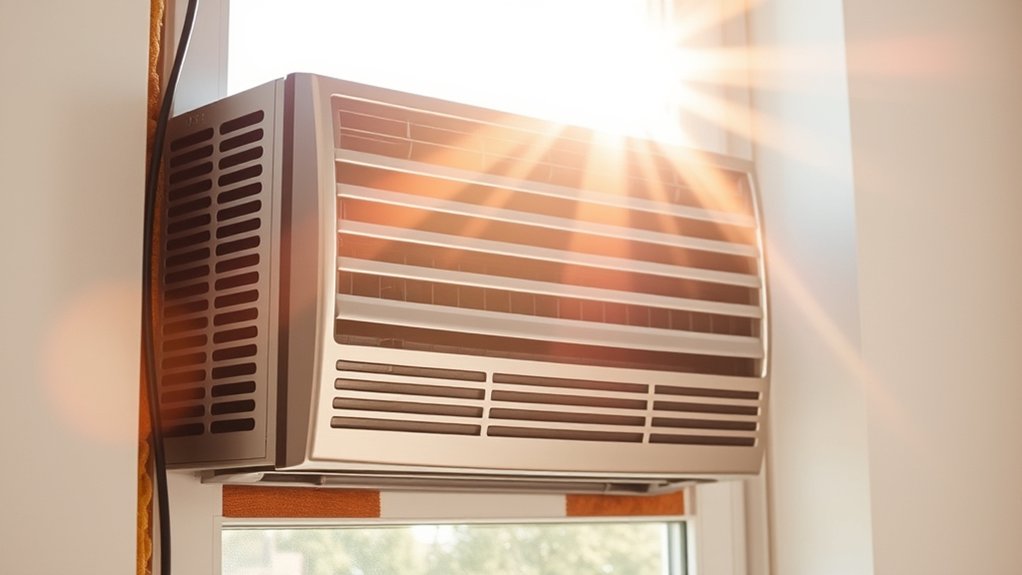
Your home’s insulation and sunlight exposure greatly affect how much cooling power you’ll need from a window AC unit. If your home isn’t well-insulated, heat leaks in during summer, making your space warmer and requiring a stronger unit.
On the other hand, if your home is well-insulated, it stays cooler longer, so you can choose a smaller, more efficient model. Sunlight exposure also matters—rooms with large sun-facing windows tend to heat up faster, increasing your cooling needs.
This means you’ll need an AC with higher capacity to keep things comfortable. Also, consider energy efficiency ratings; a high SEER rating can save you money over time, especially for larger or sunny rooms.
Keep in mind that bigger units often produce more noise. Opting for a model designed for quiet operation is a good idea, especially in bright, warm spaces.
Matching Your Budget to the Right AC Size and Features
Your budget really helps decide which AC size and features are within your reach. It’s a good idea to figure out what features are must-haves so you don’t spend more than you need to. By balancing what you want with what you can afford, you’ll end up with an efficient unit that’s just right for your needs—and your wallet.
Budget Considerations and Limits
Choosing the right window AC unit within your budget means balancing the initial cost with the features you need. Price constraints can influence your options, so it’s important to plan your finances carefully.
Set a clear budget before shopping and stick to it to avoid overspending. Keep in mind that larger units or those with advanced features usually cost more upfront, but they might save you money in energy costs over time.
Be realistic about what you can afford and focus on essential features rather than extras that could push your budget too high.
Understanding your financial limits helps you find units that offer good value without breaking the bank. Staying within your price range makes the buying process smoother and helps prevent regrets later.
Feature Prioritization Strategies
When aligning your budget with the right AC size and features, it’s important to prioritize what matters most for your cooling needs. Focus on features like energy efficiency and noise levels, which greatly impact comfort and operating costs.
For example:
| Feature | Importance |
|---|---|
| Energy Efficiency | Saves money long-term by lowering electricity bills |
| Noise Levels | Keeps your space quieter, especially in bedrooms or offices |
| Size Compatibility | Fits your room without wasting energy or causing discomfort |
| Additional Features | Like remote controls or timers, if they fit your budget |
Decide which features are non-negotiable and where you can compromise. Aim for a balance between functionality and affordability.
Cost-Performance Balance
Finding the right balance between cost and performance is key when choosing a window AC unit that fits your budget. Focus on energy efficiency to save money in the long run, as higher-efficiency models cut down on electricity bills.
Think about noise levels too, especially if you’ll use the unit in bedrooms or quiet spaces. To get the best deal, keep these points in mind:
- Choose units with good energy efficiency ratings to lower your operating costs.
- Balance features with the initial price—more features usually mean higher costs.
- Check noise level specs so you’re comfortable during use.
- Compare different models to find the best mix of performance and affordability.
Signs Your Window AC Is Too Small or Too Large
If your window AC is too small, it might struggle to cool the room effectively. You could feel hot and frustrated even when the unit runs constantly. You might also notice higher energy bills because the AC is working overtime, which reduces its efficiency.
Noise levels can go up too, as the compressor runs nonstop, making it hard to relax or sleep. On the other hand, if your AC is too large, it cools the room quickly but then turns on and off frequently. This wastes energy and causes temperature swings.
Here’s a quick comparison:
| Signs of Small AC | Signs of Large AC |
|---|---|
| Struggles to cool effectively | Cools too quickly, short cycles |
| High energy bills | Frequent cycling, wasted energy |
| Constant noise | Loud operation during short cycles |
Choosing the right size ensures your AC runs efficiently and quietly. It keeps your space comfortable without wasting energy or creating noise.
Tips for Comparing Different AC Models and Sizes Effectively
Comparing different AC models and sizes helps you find the unit that best fits your space and cooling needs. Focus on key features to make an informed choice.
First, check the energy efficiency. Look for units with high Energy Star ratings to save on electricity bills and help the environment.
Next, consider the cooling capacity. Make sure the BTU rating matches your room size. Too high and you’ll waste energy; too low and you won’t stay comfortable.
Also, pay attention to noise levels. Check decibel ratings to find models that operate quietly, especially if the unit will be in a bedroom or study.
Finally, think about additional features like smart controls, adjustable fan speeds, and dehumidification options. These can add extra comfort and convenience.
How Installation Influences Your AC’s Efficiency and Performance
Proper installation plays a crucial role in guaranteeing your window AC unit operates efficiently and effectively. When installed correctly, you’ll maximize energy efficiency and reduce your energy bills.
Follow essential tips like sealing gaps around the unit to prevent air leaks, which can hinder performance and increase energy consumption. Make sure the unit is level, as an uneven installation can strain components and decrease efficiency.
Properly insulating the window space helps maintain the right temperature and allows the AC to work less hard. Also, keep obstructions away from the vents to ensure good airflow around the unit.
Incorrect installation can cause your AC to work harder, leading to higher energy use and a shorter lifespan. Investing time in proper setup, following the manufacturer’s instructions, and sealing all gaps will help your AC operate at its best and save you money over time.
What to Do When Your Room Size Changes or You Move to a New Space
When your room size changes or you move to a new space, it’s important to reevaluate your window AC unit’s size to ensure it cools effectively. A bigger or smaller room can impact both how your space looks and how loud the unit is, so choosing the right size is key.
Start by measuring the new space accurately to figure out the right BTU rating for efficient cooling. Keep in mind that well-insulated rooms might need a smaller unit.
Measure your new space accurately to select the perfect BTU for efficient, comfortable cooling.
Think about how the new layout affects noise levels. You want to make sure your AC won’t become disruptive in the new space.
Finally, match the size of your unit with your room’s style. Avoid bulky models that clash with your decor or smaller units that can’t keep up. Proper sizing helps keep your space comfortable and peaceful.
Getting the right size makes a big difference in comfort and quietness. It helps keep noise levels low and your room looking great, making your new space cozy and quiet.
Frequently Asked Questions
Can a Larger Window AC Save More Energy Than a Smaller One?
A larger window AC unit doesn’t necessarily save more energy than a smaller one. In fact, it can be less efficient because it cools too quickly, leading to frequent cycling and higher energy use.
Plus, bigger units tend to have higher noise levels, which can be disruptive. To get the most energy-efficient and comfortable setup, pick a unit that matches your room size.
This way, it runs smoothly without wasting energy or creating too much noise.
How Does Room Shape Affect the Ideal AC Size?
Room shape affects your ideal AC size because irregular spaces or rooms with high ceilings can need more cooling power.
Think about window placement too. Make sure the unit faces the main area for more efficient cooling.
Good insulation helps keep the temperature steady, which means you might not need a bigger unit.
Is It Better to Oversize or Undersize My Window AC?
It’s better to avoid oversizing or undersizing your window AC unit. An oversized unit cools too quickly, causing it to turn on and off frequently. This reduces energy efficiency and makes more noise.
An undersized unit has a hard time cooling the room, wasting energy and leading to frustration. For the best comfort, pick a unit that fits your room size.
This ensures your AC runs efficiently and quietly, saving you money and avoiding noise disturbances.
How Often Should I Service My Window AC for Optimal Performance?
Think of your window AC as a trusted friend who needs regular check-ins. You should service your unit at least once a year, ideally before peak summer.
This maintenance schedule helps keep your energy efficiency high, so your unit runs smoothly and saves you money.
Regular cleaning of filters, coils, and vents is key to getting the best performance and extending its life.
Don’t wait for problems to show up—routine upkeep keeps your cooling system in top shape.
Are There Specific Features to Look for in a Small Versus Large AC Unit?
When choosing between small and large AC units, look for energy efficiency ratings to save on power bills and ensure effective cooling.
For small units, prioritize models with low noise levels, especially if you’ll use them in bedrooms or quiet spaces.
Large units should have features like adjustable thermostats and multiple fan speeds for better temperature control.
Ultimately, pick a unit that balances energy savings, noise levels, and your room’s specific cooling needs.
Conclusion
Choosing the right window AC size ensures you’ll stay comfortable without wasting energy. If your living room is large and gets a lot of sunlight, picking a unit with a higher BTU rating can keep it cool and cozy.
Remember, an undersized AC will struggle to cool effectively. On the other hand, an oversized one may cycle on and off too quickly, wasting energy.
Take your time to assess your space. When you choose the right size, you’ll enjoy efficient, reliable cooling all summer long.