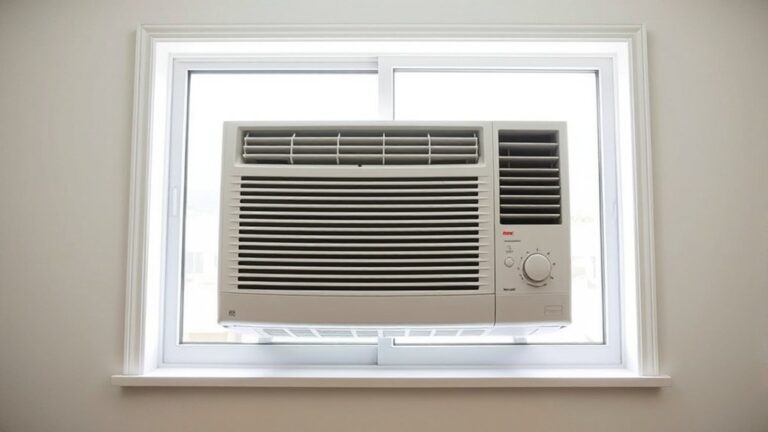
How Much Does It Cost to Run a Window AC?
Many people struggle with keeping their cool during hot days without breaking the bank. If you’re wondering how much it costs to run a window AC, you’re not alone. Understanding the expenses can help you save money and stay comfortable.
Running a window AC typically costs between a few dollars and over twenty dollars a day, depending on its size, efficiency, your usage habits, and local electricity rates.
A more efficient model with higher EER or SEER ratings will cost less to operate. Factors like room size, insulation, and thermostat settings also impact your expenses.
If you want to find out how to lower your cooling costs and optimize your unit, there’s more helpful info ahead.
Key Takeaways
- The cost depends on the AC’s wattage, how many hours you run it, and your local electricity rates. It usually ranges from just a few cents to several dollars each day.
- On average, window AC units use about 1-2 kWh daily. That’s roughly $20 to $50 a month at typical U.S. electricity prices.
- Units with higher energy efficiency ratings, like SEER or EER, help cut costs. They need less electricity to cool the same space.
- Running the AC longer or setting the thermostat lower will increase your energy use and expenses.
- Keeping the unit well-maintained and choosing the right size can prevent waste and help lower your overall operating costs.
How Much Energy Does a Typical Window AC Use Daily?
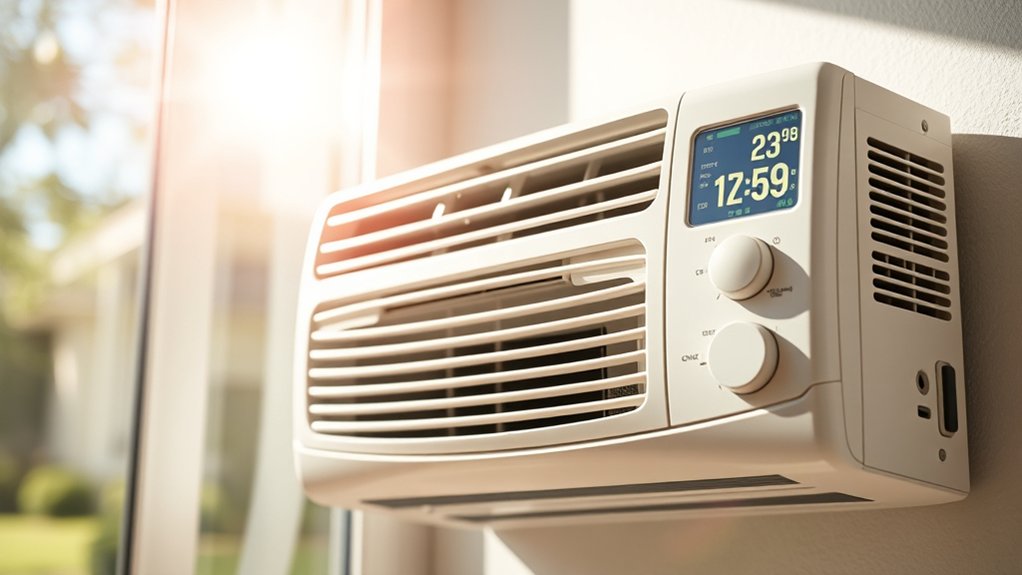
On average, a typical window AC unit consumes about 1 to 2 kilowatt-hours (kWh) of energy daily. This can vary depending on the unit’s size, efficiency, and how often you run it.
Regular window maintenance helps ensure your AC runs efficiently and prevents unnecessary energy waste. Cleaning filters and checking for obstructions keep it operating smoothly and reduce energy use.
Noise levels also affect how often you use your unit. Quieter models might encourage longer use, increasing energy consumption, while noisier units might be turned off sooner.
To keep energy use in check, listen for unusual sounds or excessive noise, which could signal maintenance issues. Proper upkeep not only minimizes noise but also helps your AC run efficiently, saving you money.
Understanding your unit’s energy use and maintaining it well allows you to manage costs while enjoying a comfortable, quiet environment.
Key Factors That Impact Your Window AC Energy Expenses
Several key factors influence how much you’ll spend on running your window AC each month. One major factor is energy-efficient upgrades. If your unit has a high Energy Efficiency Ratio (EER), it uses less electricity to cool your space, saving you money. Upgrading to a more efficient model or adding features like programmable thermostats can significantly cut costs.
Seasonal maintenance also plays an essential role. Regularly cleaning filters, coils, and vents ensures your AC runs smoothly and efficiently. Neglecting maintenance causes your unit to work harder, increasing energy consumption.
The size of your window unit matters too. An undersized or oversized unit will use more power than a properly matched, well-maintained one. Finally, proper insulation and window coverings help keep cool air inside, reducing the workload on your AC.
How to Calculate Your Monthly Window AC Electricity Bill
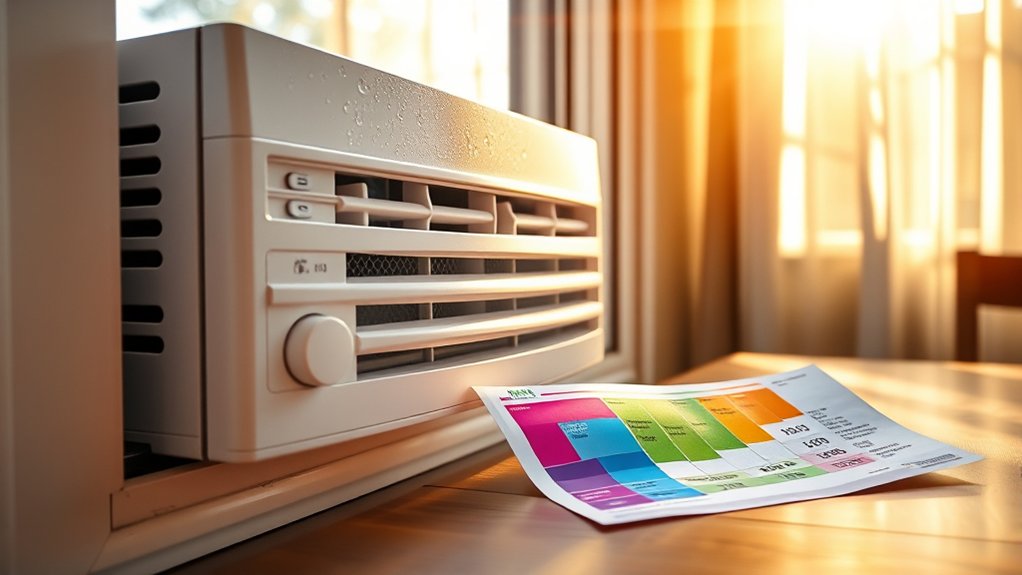
Want to get a good idea of what your monthly window AC electricity bill might look like? It’s pretty straightforward. First, check out your AC unit — it usually has the power consumption listed in watts. Once you’ve got that number, think about how many hours you typically run the AC each day.
Next, just multiply the power consumption by the number of hours you run it daily. That gives you the total energy used per day. To find out your monthly costs, multiply that number by the number of days in a month. This way, you’ll have a pretty clear picture of your overall energy expenses from running your window AC.
Determine Power Consumption
Determining your window AC’s power consumption is key to estimating your monthly electricity costs. Focus on the unit’s energy efficiency, usually indicated by the EER or SEER rating. These ratings show how well your AC converts electricity into cooling, making it easier to compare models.
Next, check the wattage label or use a power meter to perform a power measurement. The wattage tells you how much energy your unit consumes when it’s running. Multiply this wattage by the typical hours of operation per day, then by the number of days in the month.
This calculation gives you an estimate of your total energy use. Accurate power measurement and understanding energy efficiency are essential for calculating your expected electricity bill.
Calculate Operating Hours
Ever wonder how many hours your window AC runs each day? Knowing this helps you estimate your energy efficiency and compare costs more accurately.
To figure out your operating hours, start by tracking when you turn the unit on and off each day for a week. Then, add up the total hours to find your average daily runtime.
Next, multiply that by the number of days in a month to get your monthly operating hours. This number is key for a precise cost comparison since your electricity bill depends on how long your AC runs.
Keep in mind, more hours mean higher costs, especially if your unit isn’t energy efficient. Monitoring your run time helps you make smarter decisions about usage and potential upgrades for better energy savings.
What Do EER and SEER Ratings Mean for Your Window AC?
EER and SEER ratings are key indicators of your window air conditioner’s efficiency. They help you make smarter choices when picking a unit. The EER measures how well your AC uses electricity to cool at a specific temperature, while SEER looks at efficiency over an entire cooling season.
Higher ratings mean your AC uses less energy to provide the same cooling power, which saves you money.
Here’s a quick comparison:
| Rating Type | What It Measures | Typical Range |
|---|---|---|
| EER | Efficiency at a fixed temperature | 8 to 12 |
| SEER | Seasonal efficiency | 13 to 20 |
| Impact | Lower EER/SEER = Higher costs | Higher ratings save money |
| Usage | Choose based on climate & needs | Higher for hot climates |
Knowing these ratings helps you pick an energy-efficient window AC that keeps your running costs low.
How Room Size and Insulation Affect Your Cooling Costs
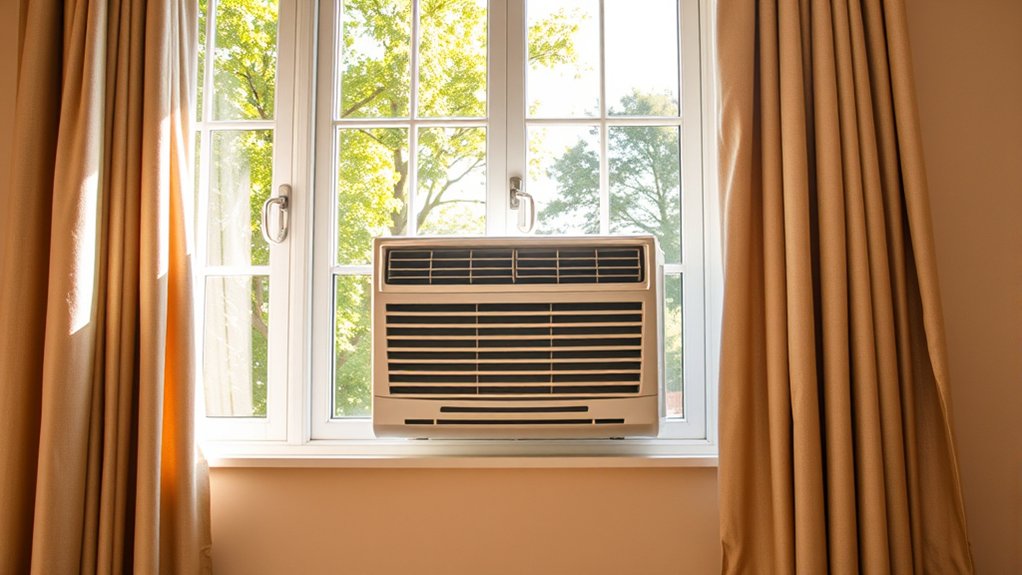
The size of your room and its level of insulation are key factors in how much your window AC will cost to run. Larger rooms need more cooling power, which uses more energy and boosts your bills. If your room is too big for your unit, it has to work harder, making your energy costs go up.
On the flip side, smaller rooms cool more efficiently, helping you save money. Improving insulation can also cut cooling costs a lot by stopping warm air from coming in and cool air from escaping. Simple fixes like sealing gaps around windows or adding curtains can make your AC run more efficiently.
Smaller rooms cool efficiently; sealing gaps and adding curtains boost AC performance and save money.
You can also optimize cooling by adjusting room size—closing off unused areas or using fans to circulate air. These little tricks help your AC work less, saving you money while keeping you comfortable.
Managing room size and insulation properly directly affects your cooling costs and overall energy efficiency.
Comparing Costs of Different Window AC Sizes
Choosing the right window AC size directly impacts your running costs. A unit that’s too small will struggle to cool your space, making it run constantly and increasing energy bills. Conversely, an oversized AC cools quickly but wastes energy, leading to higher costs and unnecessary wear.
When comparing different sizes, think about how window placement affects efficiency and noise levels. Smaller units are quieter and easier to install in tight spaces, while larger units may produce more noise and need stronger window support.
Properly matching the AC size to your room ensures better energy use and comfort. Smaller units are ideal for tiny rooms, offering lower noise levels and energy consumption. Larger units can cool faster but often run longer, which increases costs.
Remember that window placement influences efficiency. Centered placement usually works best. Also, note that noise levels tend to increase with size, so choose accordingly if quiet operation is important.
Tips to Reduce Your Window AC Energy Consumption
To cut down on your window AC’s energy consumption, start by keeping your indoor temperature comfortable. Setting it too low makes your unit work harder than it needs to.
Use a programmable thermostat or timer so your AC isn’t running when you don’t need cooling. Upgrading with energy-efficient seals and better insulation helps keep cool air in and warm air out.
These small changes reduce the load on your AC and help you save energy. You can also try alternative cooling methods like fans or evaporative coolers, which use less power.
Regularly cleaning filters is important too. It keeps your AC running efficiently and ensures good airflow.
| Tip | Benefit |
|---|---|
| Install energy-efficient upgrades | Lower energy costs and better cooling |
| Use alternative cooling options | Reduce dependence on your AC |
| Maintain filters regularly | Improve efficiency and airflow |
When Should You Upgrade to a More Efficient Window AC?
If your current window AC struggles to cool your space or runs constantly without providing relief, it’s probably time to consider an upgrade.
An energy-efficient model can save you money over time and make your space more comfortable.
Think about upgrading if your unit is over 10 years old, since newer models tend to have better energy ratings.
If your cooling bills are unusually high even with minimal use, a more efficient AC can help cut costs.
Smart thermostats can also boost performance by letting you control the temperature remotely and improving efficiency.
If your current unit is noisy or unreliable, upgrading can make your environment more peaceful and dependable.
Look for models with higher SEER ratings and energy-saving features to get the most savings.
Upgrading at the right time means you’ll benefit from the latest technology and lower operating costs.
This makes your cooling system more effective and economical, giving you better comfort and savings in the long run.
How Your Usage Patterns Influence Cooling Expenses
Your cooling expenses are heavily influenced by how you use your window AC. The outdoor temperature plays a big role; when it’s very hot outside, your unit has to work harder, which boosts energy costs.
Your window AC costs rise when outdoor temperatures are high and the unit works harder.
To cut down on this, try keeping blinds or curtains closed during the hottest parts of the day. This helps reduce indoor heat gain and keeps your space cooler.
Your usage habits matter too. Running the AC all the time or setting it to a very low temperature will make costs go up. Instead, use energy-saving settings and only turn it on when you really need to.
Regular maintenance can also save you money. Cleaning or replacing filters and checking for leaks helps your AC run more efficiently. This prevents it from overworking and reduces energy use.
Keeping an eye on outdoor temperatures and sticking to a routine maintenance schedule helps control your cooling costs. It keeps your window AC running smoothly and efficiently, saving you money in the long run.
Budgeting for Your Window AC Operating Costs
Budgeting for your window AC operating costs means understanding your typical usage and estimating your monthly expenses. Start by looking at the unit’s energy efficiency; an ENERGY STAR-rated model uses less power and saves you money over time.
Next, think about maintenance costs like cleaning filters or occasional repairs. While these can add up, they help keep your unit running smoothly. To get a clear picture, track your energy bills during the hottest months to see how much you’re actually using.
Keep in mind that running your AC during the peak heat days will increase your costs, so plan for those higher expenses. Setting a reasonable thermostat temperature can help cut down on energy use without sacrificing comfort.
Monitor your energy efficiency ratings to choose units that are more cost-effective. Scheduling regular maintenance can also prevent costly repairs down the line. Setting a consistent, moderate temperature will lead to savings, and estimating seasonal changes in cooling needs helps with better budgeting.
Frequently Asked Questions
What Are the Hidden Costs of Running a Window AC?
The hidden costs of running a window AC include increased energy bills if the unit isn’t energy-efficient. Poor efficiency means it uses more electricity, which can catch you off guard with higher costs.
Also, running the unit frequently can shorten its lifespan, leading to potential replacement expenses. To avoid these hidden costs, pick an energy-efficient model and do regular maintenance.
This way, your AC runs better and lasts longer, saving you money in the long run.
How Does Local Electricity Rate Affect Overall Costs?
Your local electricity rates directly impact your window AC’s overall costs because higher rates increase the expense of power consumption.
If your unit has high energy efficiency, it uses less electricity, reducing costs even in areas with higher rates.
Conversely, a less efficient model consumes more power, making utility bills steeper.
To save, choose an energy-efficient window AC and be mindful of your local electricity rates to manage your expenses effectively.
Do Maintenance and Repairs Impact the Operating Expenses?
Maintenance and repairs do impact your operating expenses, but keeping your window AC energy efficient helps keep costs down. Regular maintenance tips, like cleaning filters and coils, make sure your unit runs smoothly and uses less power.
Addressing repairs promptly prevents small issues from turning into costly problems, which can help reduce your energy bills. Staying proactive with maintenance keeps your AC operating efficiently and saves you money on energy costs over its lifespan.
Can Using a Timer Save Energy and Money?
Using a timer can greatly save energy and money by preventing your window AC from running longer than necessary. This smart strategy helps cut down on wasted electricity.
Scheduling your AC’s operation reduces unnecessary use, which can lead to noticeable savings over time. It’s an easy way to keep your home cool without overspending.
How Does the Climate in My Area Influence Cooling Costs?
The climate in your area directly influences your cooling costs. If you experience hot summers or climate variability, you’ll probably spend more on cooling.
Seasonal adjustments, like setting your AC higher during milder days, can help cut down on energy use and save money.
In regions with consistent heat, investing in energy-efficient models or alternative cooling methods can really make a difference.
Always adapt your cooling habits to your local climate for the best savings.
Conclusion
Understanding your window AC’s costs isn’t just about numbers. It’s about reclaiming comfort and peace of mind.
By paying attention to efficiency ratings, usage habits, and room insulation, you can lower your bills and stay cool without breaking the bank.
Don’t let high costs freeze your comfort. Take control today and turn your home into a haven.
Because every dollar saved is a gust of fresh air in your budget—and knowing how much it costs to run a window AC helps you make smarter choices.