How Much Electricity Does a Window AC Use Per Month?
Many people struggle with high electricity bills during the hot months, especially when running their air conditioners frequently. If you’re looking for ways to save money and stay cool, understanding how much power your window AC uses can make a big difference.
A window AC typically uses between 150 and 300 kilowatt-hours of electricity per month, depending on your unit’s size, efficiency, and how often you run it. Larger or older units tend to consume more power, especially if your room isn’t well-insulated or if you keep the thermostat set low.
To cut down your bill, you can adjust settings and maintain your AC regularly. If you want to learn more ways to save energy, keep exploring.
Key Takeaways
- A typical window AC uses between 150 to 300 kWh per month, depending on its size and efficiency.
- For example, a 1,000-watt unit running 8 hours a day will consume about 240 kWh each month.
- Smaller units designed for 100-200 sq ft rooms usually use around 150-200 kWh per month.
- Older, less efficient models tend to use more energy compared to newer, high-efficiency ones.
- Keeping your AC well-maintained and using it at optimal settings can help cut down your monthly electricity bills.
How Much Electricity Does a Typical Window AC Use?
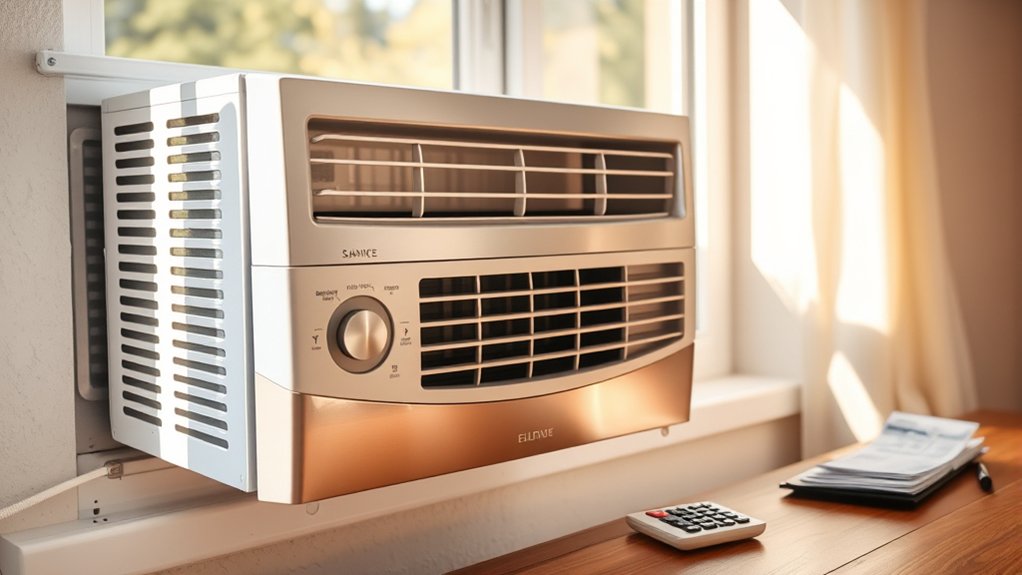
A typical window air conditioner uses between 500 and 1,500 watts of power when it’s running. The exact amount depends on the size, age, and efficiency of the unit.
To estimate your monthly energy use, think about how many hours you run it each day. For example, running a 1,000-watt unit for eight hours a day adds up to around 240 kilowatt-hours a month.
Running a 1,000-watt AC for eight hours daily uses about 240 kWh monthly.
You can save on energy bills by setting the thermostat higher when possible and using fans to help cool the space. Regular maintenance, like cleaning or replacing filters and clearing debris, keeps the unit working efficiently.
Taking care of your window AC reduces strain on the compressor, which means it uses less energy. Keeping it well-maintained ensures it runs smoothly and saves you money over time.
These simple steps can really make a difference in your monthly energy costs and help your unit last longer.
What Factors Affect Your Window AC’s Monthly Energy Consumption?
Several factors directly influence how much electricity your window AC consumes each month. One key factor is how often you run the unit and at what temperature. Setting your thermostat too low can cause your AC to work harder, increasing energy use.
Using smart thermostats helps optimize cooling schedules, reducing unnecessary operation. The size and insulation of your space also matter; poorly insulated rooms require more cooling, raising energy consumption.
Furthermore, the efficiency of your AC — indicated by its Energy Efficiency Ratio (EER) — plays a role. If you rely on renewable energy sources, your overall environmental impact decreases, even if your consumption remains high.
Proper maintenance, like cleaning filters and coils, ensures your AC runs efficiently. Overall, adjusting your settings, improving insulation, and integrating smart technology can significantly influence your monthly energy use, helping you save money and reduce your carbon footprint.
How to Calculate Your Window AC’s Power Use in Kilowatt-Hours
Want to figure out how much energy your window AC is using in kilowatt-hours? It’s pretty straightforward. First, look for the power rating on the unit—it’s usually on a label or tag, and it’s given in watts or sometimes in kilowatts.
Next, think about how many hours you run your AC each day. Once you have that, just multiply the power rating by the number of hours to get your daily energy use. For example, if your AC is rated at 1,000 watts and you run it for 8 hours, that’s 8 kilowatt-hours each day.
To see how much you’re using in a month, multiply that daily number by the number of days you run it. And if you want to understand your total energy consumption in kilowatt-hours, that’s pretty much it! It’s a handy way to keep track of your energy use and maybe even save some money.
Find the AC’s Power Rating
Understanding your window AC’s power rating is key to estimating how much energy it uses. You can usually find this info on the unit’s label or in the user manual.
The power rating is measured in watts (W) or kilowatts (kW). When picking an AC, think about color options—some sleek models blend better with your room decor.
It’s also a good idea to check the brand’s reputation. Reputable brands often give accurate ratings and reliable performance.
This rating shows how much power the unit consumes when running at full capacity. Knowing this helps you estimate your energy usage, especially when you consider your hours of use.
Getting an accurate power rating is the first step in figuring out your monthly electricity costs effectively.
Calculate Monthly Usage
Once you know your window AC’s power rating, calculating its monthly energy use is pretty simple. First, figure out how many hours you run it each day.
Next, multiply that by the power rating in kilowatts to get your daily energy consumption. Then, multiply that number by the number of days in the month.
To save on costs, try tips like setting the thermostat higher or using fans. Regular maintenance, like cleaning filters and checking seals, can also help your unit run more efficiently.
Here’s a quick summary:
- Record how many hours it runs daily
- Convert watts to kilowatts
- Multiply by daily usage
- Multiply by days in the month
- Use energy-saving tips and do routine maintenance
Following this method will give you accurate calculations and help your AC run more efficiently.
Convert to Kilowatt-Hours
Ever wondered how to convert your window AC’s power rating from watts into a more useful unit like kilowatt-hours? To do this, divide the wattage by 1,000 to get kilowatts, then multiply by the hours of operation.
This calculation helps you track energy consumption more accurately, supporting eco-friendly tips and smart technology use. Here’s a simple visual:
| Step | Explanation |
|---|---|
| Convert watts to kilowatts | Divide watts by 1,000 |
| Multiply by hours used | Find total kWh consumed per day |
| Summarize monthly use | Multiply daily kWh by days in the month |
Knowing your AC’s energy in kWh helps you optimize usage and reduce costs, especially with smart tech that can automate eco-friendly settings.
Estimate Your Monthly Electricity Costs for a Window AC
Your monthly electricity bill for your window AC really depends on a few things, like how energy-efficient your unit is and how often you keep it running. To get a good idea of what you might be spending, you’ll want to consider your local electricity rates and how much power your AC uses. Once you have that info, it becomes much easier to estimate your monthly costs and stay on top of your budget.
Factors Affecting Power Consumption
Several factors influence how much electricity a window AC consumes each month, so it’s important to keep them in mind when estimating your costs. Your unit’s energy use depends on several elements:
Room size: Larger spaces need more cooling, which means higher power consumption.
Air quality: If the air quality isn’t great, the AC has to work harder, using more energy.
Noise levels: Quieter units often run more efficiently but might cost more upfront.
Usage patterns: Running the AC continuously or only periodically makes a difference in total energy use.
Thermostat settings: Setting the temperature lower requires more energy to keep, increasing your bill.
Knowing these factors can help you better estimate your monthly electricity costs and pick a unit that fits your needs.
Calculating Monthly Costs
Estimating your monthly electricity costs for a window AC involves understanding its power consumption and your usage.
Start by checking the unit’s wattage and multiply it by your average daily hours of use to find daily energy consumption. Then, multiply that by the number of days you run the AC each month.
To save money, focus on energy conservation. Set your thermostat at an efficient temperature and avoid running the AC when you don’t need it.
Regular maintenance like cleaning filters and sealing leaks helps your AC run smoothly and uses less electricity, which cuts costs.
Keep an eye on your energy use through utility bills or a smart meter. Adjust your habits and maintain your AC to save money and conserve energy over time.
How Room Size and Insulation Impact Your AC’s Energy Usage
The size of your room and how well it’s insulated really affect how much electricity your window AC uses. A bigger room needs more cooling power, which means higher energy use, especially if the insulation isn’t great.
Where you place your window unit matters too. Putting it in a shaded or cooler spot can help it work more efficiently and reduce energy consumption. During hot months, your AC has to work harder, using more power, while in cooler seasons, it doesn’t have to run as much.
Good insulation helps keep heat out or in, so your AC doesn’t have to run constantly to keep your space comfortable. Think about these factors to make your AC more efficient and save on your electricity bill.
- Larger rooms need more cooling, which boosts energy use
- Poor insulation allows heat to enter, raising power consumption
- Window placement impacts airflow and efficiency
- Seasonal changes can make your AC work harder or less
- Better insulation cuts down on overall electricity use
Tips for Lowering Your Window AC’s Power Bill
To lower your window AC’s power bill, start by setting the thermostat to the highest comfortable temperature, usually around 78°F during the day. Avoid lowering it unnecessarily to save energy.
Regular air filter maintenance is essential. A clean filter improves airflow and cooling efficiency, which helps reduce energy consumption. Check and replace filters monthly or as recommended.
Use the remote control settings wisely: set the fan to “auto” so it runs only when needed. Avoid running the unit in “fan only” mode unless necessary.
Keep blinds or curtains closed during peak sunlight hours to minimize heat gain. Make sure windows are sealed tightly to prevent cool air from escaping.
Using programmable timers can help turn the AC off during cooler parts of the day or night. These small adjustments can significantly lower your energy use and save you money while keeping your space comfortable.
Comparing Energy Efficiency Ratings of Window AC Units
Are you wondering how to choose the most energy-efficient window AC unit? Comparing energy efficiency ratings helps you make informed decisions.
Over time, historical trends show improvements in SEER (Seasonal Energy Efficiency Ratio) ratings, reflecting advancements in technology. Regional variations also matter; units with higher efficiency may be more common or better suited to specific climates.
To compare effectively, consider:
- SEER ratings: Higher numbers mean more efficiency.
- EER ratings: For specific cooling conditions, higher EER indicates less energy use.
- Energy Star certification: Ensures the unit meets strict efficiency standards.
- Age of the unit: Newer models generally perform better.
- Regional climate: Cooler areas might prioritize different features than hotter regions.
Understanding these factors, along with historical trends and regional differences, helps you select an AC that balances performance and energy savings. This can ultimately lower your monthly electricity costs.
Real-World Examples of Window AC Electricity Usage
Real-world examples can really help you get a sense of how much electricity your window AC might use each month. Of course, the actual amount depends on things like the size of your room, how often you run the unit, and how energy-efficient your AC is.
Thinking about these factors can give you a better idea of what your energy costs might look like and how to make your AC work more effectively. It’s all about understanding your habits and your unit’s performance to keep things running smoothly and save some money in the long run.
Typical Monthly Consumption
Understanding how much electricity your window AC uses each month can vary quite a bit depending on the unit’s size, efficiency, and how often you run it.
On average, a typical window AC consumes between 150 to 300 kWh per month. This depends on the cooling capacity and your usage habits. For example, a smaller unit might use around 150 kWh, while an older, larger model could reach 300 kWh.
Keep in mind, higher energy use can affect indoor air quality and noise levels, which can impact your comfort and sleep.
Smaller units designed for 100-200 sq ft usually use 150-200 kWh per month. Larger units for spaces over 300 sq ft tend to consume 250-300 kWh monthly.
Your usage habits also matter. Running the AC for about 8 hours a day keeps consumption toward the lower end, while running it for 12 or more hours pushes it higher.
Older units tend to use more energy than newer, more efficient models.
Factors Influencing Usage
Several factors can greatly influence your window AC’s electricity usage, making actual consumption vary widely from the average estimates. One key factor is window maintenance; a clean, well-sealed window ensures better insulation and less energy waste.
Poor sealing or dirt buildup can cause your AC to work harder, increasing power consumption. Noise levels also matter—if your unit produces loud sounds, it may be struggling, indicating inefficiency and higher energy use.
Moreover, frequent adjustments or running the unit constantly instead of using a timer can raise consumption. Properly maintaining your window AC, including cleaning filters and sealing gaps, helps optimize efficiency.
Being mindful of noise levels and operational habits guarantees you don’t unknowingly boost your energy bills.
When Is It Time to Upgrade Your Window AC to a More Efficient Model?
If your window AC struggles to keep your space cool or has become noticeably louder, it’s probably time to think about an upgrade. An inefficient unit can drive up energy costs and hinder your comfort. Consider upgrading when:
- You notice frequent breakdowns or repairs
- Your energy bills spike unexpectedly
- Your AC no longer cools effectively
- You want to integrate smart thermostats for better control
- You’re interested in using renewable energy options for sustainability
Modern models are more energy-efficient and can be paired with smart thermostats, allowing you to optimize usage and save money. They often feature eco-friendly refrigerants and better insulation, reducing overall electricity consumption. Upgrading also helps reduce your carbon footprint and aligns with a sustainable lifestyle.
If your current window AC no longer meets your needs, investing in a newer, more efficient model is a smart choice for comfort, savings, and environmental impact.
Final Tips to Reduce Your Window AC’s Energy Consumption
To maximize energy savings, start by setting your window AC to around 78°F when you’re at home. Avoid lowering it unnecessarily, as cooler settings can significantly boost electricity use.
Using energy-saving appliances like a programmable thermostat or smart controls can help regulate temperature efficiently. Regularly cleaning or replacing filters improves airflow and reduces strain on the unit, lowering energy consumption.
Sealing gaps around your windows prevents cool air from escaping, making your AC work less hard. Consider adding renewable energy sources like solar panels to offset electricity costs and reduce your environmental impact.
During cooler months, turn off or unplug your AC to save energy. If possible, use fans or natural ventilation to supplement cooling. These small changes can dramatically cut your window AC’s power use, saving you money and helping the environment while keeping your home comfortable.
Frequently Asked Questions
How Does Outdoor Temperature Influence Window AC Energy Consumption?
Outdoor temperature affects how much energy your window AC uses, causing fluctuations as temperatures go up or down. When it gets hotter outside, your AC has to work harder to cool your space, which means higher energy use.
On the other hand, cooler outdoor temperatures put less strain on your unit, helping it use less electricity. So, the outdoor temperature really impacts your window AC’s monthly energy consumption, with hot days leading to increased energy use.
Do Different Brands Have Varying Energy Efficiencies?
Different brands dance to different tunes of energy efficiency. You’ll find that some units, especially those with the Energy Star label, sip electricity more sparingly than others.
When doing a brand comparison, look for models with high SEER ratings and positive reviews. This guarantees you get a window AC that cools effectively and keeps your energy bills in check.
Making this choice is a smarter, greener move.
Can Using a Programmable Thermostat Reduce AC Electricity Use?
Yes, using a programmable thermostat can significantly cut down your AC electricity use. By setting it to adjust temperatures when you’re away or asleep, you avoid unnecessary cooling and save energy.
This automation helps optimize your air conditioning, leading to lower bills and better energy savings. It’s a smart way to manage your home’s temperature without sacrificing comfort, especially during hot months when your window AC runs often.
How Does the Age of the AC Affect Its Energy Efficiency?
As your window AC gets older, it’s like a tired traveler losing its energy-saving features and efficiency. Older units often need more power to cool the same space, making them less effective.
Dust and wear over time can really drag down performance, which means higher electricity bills. Plus, installation can become trickier with age, adding to the hassle.
Upgrading to a newer model is a smart move. It guarantees better efficiency and helps save you money and energy.
A modern, well-maintained AC can effortlessly keep your room cool and comfortable, making your summer days much more enjoyable.
Are There Specific Maintenance Tips to Lower Power Consumption?
To lower your window AC’s power consumption, regularly clean or replace the filter to keep airflow efficient.
Also, seal gaps around the unit and windows to prevent cool air from escaping and warm air from entering.
These simple maintenance tips improve efficiency, helping your AC work less and use less electricity.
Consistent upkeep guarantees your unit runs smoothly, saving you money on energy bills in the long run.
Conclusion
To keep your comfort levels steady without overextending your energy use, it’s smart to pay attention to your window AC’s efficiency and how you operate it.
A small change today can gently steer your energy consumption in a more sustainable direction, helping you save on costs and reduce your environmental impact.
Remember, sometimes a little upgrade or mindful operation can softly guide you toward more efficient cooling, making every month a little easier on your wallet and the planet.
When you consider how much electricity a window AC uses per month, being mindful of its efficiency can really make a difference in your energy bills.