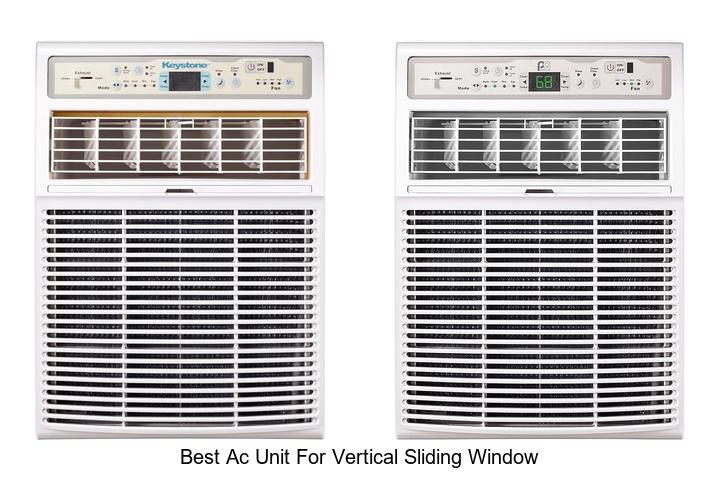
How Much Does It Cost to Run a Window AC Unit?
Feeling the heat and trying to stay cool can be a real challenge, especially when electricity bills start to rise. Many people struggle with managing cooling costs while keeping their homes comfortable.
If you’ve ever wondered how much it really costs to run a window AC unit, you’re not alone.
Running a window AC unit typically costs between $0.90 and $2.00 per day, depending on its size, efficiency, and your local electricity rates.
Using a more efficient model, sealing leaks, and adjusting your thermostat can help lower your expenses.
Your costs also depend on how often and how long you operate the unit.
Want to find ways to save even more? Keep exploring to learn helpful tips and considerations.
Key Takeaways
- Running a 1,000-watt window AC for 8 hours costs about $0.96 daily at $0.12 per kWh.
- Monthly costs vary based on wattage, how many hours you run it, and your local electricity rates.
- Units with higher efficiency ratings, like better SEER or EER, help cut down energy use and save you money.
- Things like good insulation, thermostat settings, and your regional climate also play a big role in how much you spend.
- Proper installation and regular maintenance can boost efficiency and help lower your overall running costs.
How Much Does It Cost to Run a Window AC?
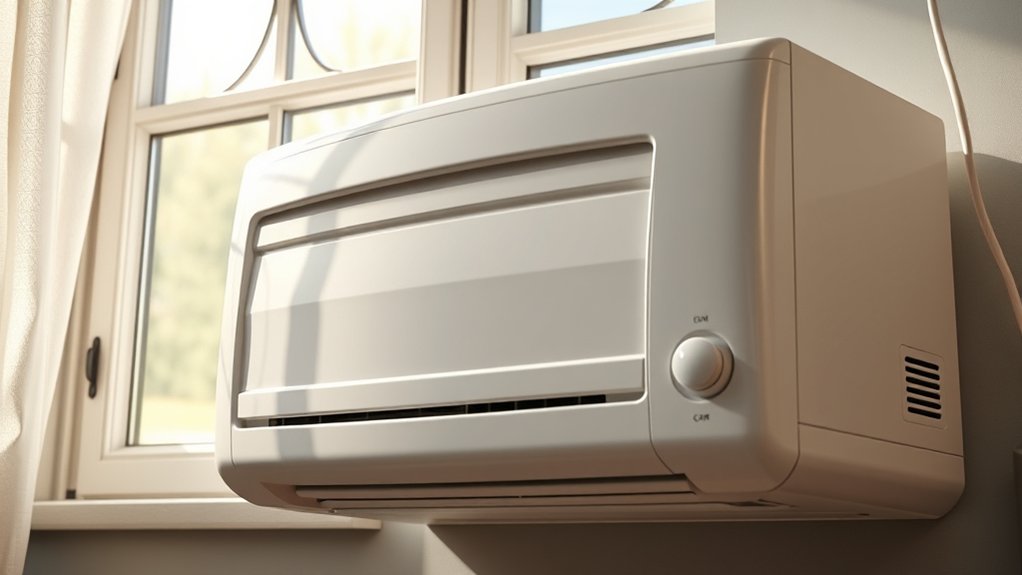
When it comes to cooling your home, understanding the cost to run a window AC helps you manage your energy bills. Your energy use directly impacts how much you’ll pay each month.
Typically, a window unit uses between 500 to 1,500 watts, depending on its size and efficiency. To estimate costs, multiply the unit’s wattage by the hours you run it and your local electricity rate.
Window ACs typically consume 500 to 1,500 watts; multiply by usage hours and local rates to estimate costs.
For example, running a 1,000-watt AC for 8 hours at $0.12 per kWh costs about $0.96 daily. Comparing different models can help you find the most efficient and cost-effective option for your needs.
Higher-efficiency units may cost more upfront but can save you money over time through lower energy use. Knowing these factors helps you make smarter choices and keep your cooling costs within budget.
Understanding How Window AC Units Use Electricity
Understanding how window AC units use electricity involves knowing how their components draw power during operation. When you turn on your unit, the compressor, fan, and condenser work together, consuming electricity to cool your space. Proper window installation ensures the unit runs efficiently, preventing air leaks that increase energy use.
Airflow optimization is key. If airflow is restricted, the AC has to work harder, which means it uses more electricity. Here are three main factors that influence power use:
- The compressor’s cycle: It runs intermittently, and its run time affects energy consumption.
- Fan speed settings: Higher speeds draw more power, so managing these helps control costs.
- Seal integrity: Gaps or poor installation cause leaks, forcing the unit to overwork.
Understanding these elements helps you operate your window AC more efficiently, saving energy and cutting costs.
What Factors Affect Your Cooling Costs?
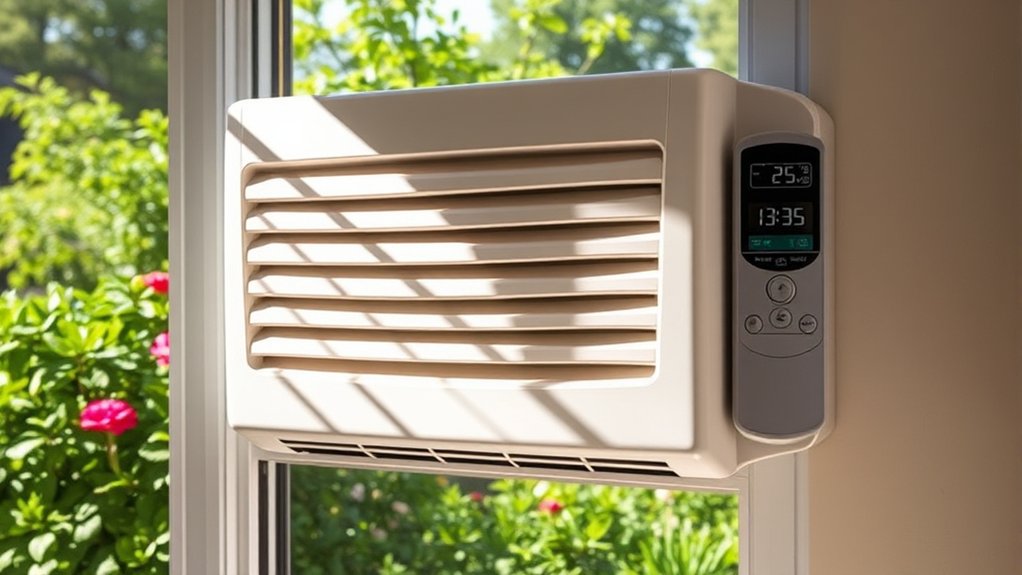
Several key factors directly influence your cooling costs when using a window AC unit. First, window insulation plays a big role. Poor insulation allows heat to seep in, making your unit work harder and use more electricity. Ensuring your window is well-sealed reduces this heat transfer and cuts costs.
Second, thermostat settings significantly impact your energy use. Setting the thermostat lower than necessary increases power consumption. Keeping it at a comfortable, moderate temperature helps save money.
Moreover, the size and efficiency of your AC unit matter. Larger or less efficient models use more energy. The local climate and how often you run the unit also influence costs. Hotter weather or longer operation increases expenses.
How to Calculate the Monthly Operating Cost of Your Window AC
Want to figure out how much your window AC is costing you each month? It’s pretty straightforward! First, look at your AC unit’s power consumption, which is usually listed in watts on the label or in the manual. Once you have that number, think about how many hours you run your AC each day.
Then, multiply those daily hours by the number of days in the month to get the total hours your AC is on for the month. The final step is to check your electricity rate, which you can find on your bill, and use it to calculate the overall cost. It’s a simple way to see how much your cooling habits are costing you!
Determine Power Consumption
Determining your window AC unit’s power consumption is key to estimating your monthly running costs. To do a good energy use analysis, you need to know how many watts it consumes.
Start by checking the unit’s label or manual for its wattage, amperage, and voltage ratings. Then, follow these steps:
- Find the AC’s wattage rating or calculate it by multiplying amperage by voltage.
- Use the energy efficiency ratio (EER) or a power analysis to estimate how much energy it uses each day.
- Multiply the daily energy use by the number of days you plan to run the AC each month to get your total monthly energy costs.
Calculate Usage Hours
Knowing how many hours your window AC runs each day is key to accurately calculating your monthly operating costs. To figure this out, track the daily runtime over a week and find the average.
This helps you understand your energy use and spot chances to save energy. Estimating hours of operation lets you compare costs between different units or usage habits more precisely.
Keep in mind, the longer your AC runs, the more energy it uses. Cutting down on runtime can help you save money. Accurate calculations give you the info you need to set thermostats wisely or consider upgrading to more efficient models.
In the end, knowing your usage hours lets you balance comfort with saving money, making your energy management smarter and more cost-effective.
Assess Electricity Rates
Ever wonder how much your electricity bill really costs to run your window AC? To figure this out, start by checking your utility’s rate per kilowatt-hour (kWh). Then, think about where your AC is placed—areas with direct sunlight might make it work harder, increasing your energy use.
Also, pay attention to noise levels; a quieter unit could be more efficient, saving you money. Here’s how to get an accurate estimate:
- Find your AC’s wattage and convert it to kilowatts.
- Multiply that by your average daily usage hours.
- Then multiply the result by your local electricity rate per kWh.
This way, you’ll understand your monthly costs based on electricity rates, window placement, and noise levels. It gives you a clear picture of what your AC really costs to run.
What Is the Average Cost to Run a Window AC in 2023?
In 2023, how much you spend to run a window AC each month really depends on a few things—like the size of your unit and how often you turn it on. If you have a bigger or more powerful AC, chances are it’s going to use more energy. Likewise, the more you run it, the higher your costs will be.
Plus, your local energy rates play a big role. Some areas pay a lot more per kilowatt-hour than others, so your monthly bill can vary quite a bit depending on where you live. Knowing these factors can help you get a better idea of what to expect and maybe even find ways to save some money.
Average Monthly Energy Use
On average, a window AC unit uses about 1 to 2 kilowatt-hours (kWh) of electricity each hour it’s running. Over a month, that adds up to roughly 30 to 60 kWh, depending on how much you use it.
Energy use has gone up a bit over the years, partly because newer models tend to be more powerful. Regional differences also play a role—hotter places like the South usually see higher monthly energy bills.
To estimate your costs, think about these things: how many hours you run your AC each day, what your local electricity rates are—which can vary a lot—and how efficient your unit is, since that affects overall energy use.
Getting a handle on these factors can help you better understand your typical monthly energy consumption and plan for costs in 2023.
Factors Influencing Costs
Several key factors directly influence how much you’ll spend to run a window AC in 2023. Your window placement can make a big difference. If it’s shaded or faces the sun, your unit works harder, which increases costs.
Noise levels also matter. Quieter models tend to be more efficient but may cost more upfront. Longer usage will also increase your expenses over time.
Understanding these factors helps you control your energy bills. Proper window placement and choosing the right noise level can make your cooling more affordable and less stressful.
How Efficiency Ratings Impact Your Electricity Bills
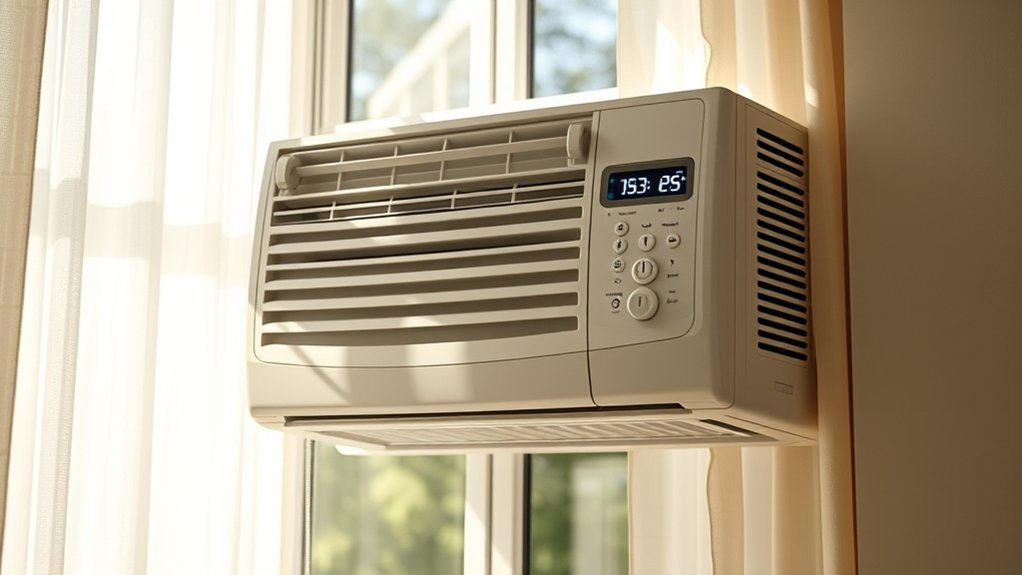
Efficiency ratings play a crucial role in determining how much you’ll spend on running your window AC unit. Higher efficiency ratings mean your unit uses less energy to cool your space, which can lead to big savings.
When shopping for an AC, look for models with a high Seasonal Energy Efficiency Ratio (SEER) or Energy Efficiency Ratio (EER). These ratings directly impact your monthly electricity bills.
Here’s how they affect your costs:
- Better Efficiency, Lower Bills: An AC with a higher SEER or EER uses less electricity, so your bills are lower.
- Long-Term Savings: Although more efficient models may cost more upfront, they save you money over time through reduced energy costs.
- Environmental Benefits: Higher efficiency ratings also mean fewer emissions, helping the environment while saving you money.
Choosing an AC with good efficiency ratings helps maximize your energy savings and keep your costs manageable.
Comparing the Most Energy-Efficient Window AC Models
When you’re looking at energy-efficient window AC models, it’s helpful to pay attention to some key features. Things like inverter technology and programmable thermostats can really make a difference when it comes to saving money on your energy bills.
Some models are better than others because they have higher SEER ratings and offer smart controls, which can make managing your cooling a lot easier and more cost-effective.
Top Energy-Efficient Features
If you’re aiming to cut energy costs, focusing on the key features that make a window AC unit energy-efficient can really help. Top models often include adjustable fan speeds, energy-saving modes, and smart thermostats that optimize power use.
Pay attention to window placement too—properly sealing and positioning your unit reduces energy waste. Noise levels matter as well; quieter units typically operate more efficiently because they run smoothly without excessive cycling.
To maximize efficiency, look for units with variable-speed compressors for precise temperature control. High Energy Efficiency Ratio (EER) ratings indicate better performance, and sound insulation features help minimize noise and reduce unnecessary power use.
These features work together to optimize energy use and can lower your overall running costs.
Best Models for Savings
Choosing the right window AC unit can significantly affect your energy bills, especially if you go for models with top-tier efficiency. Look for units with high Energy Efficiency Ratios (EER) or Seasonal Energy Efficiency Rat Ratios (SEER), since they use less power.
When picking a model, think about how your window placement impacts efficiency. Installing the unit correctly ensures better airflow and less energy waste. Also, pay attention to noise levels—quieter models often feature advanced insulation and better compressor tech, making them more comfortable to use without disturbing your space.
Some of the best savings models include those with inverter technology, which adjusts cooling based on demand. Units with smart features can also optimize performance and save energy. These choices help lower your overall energy consumption and operating costs.
When Should You Upgrade Your Window AC to Save Money?
Upgrading your window AC unit can lead to big savings, especially if your current system isn’t working efficiently or reliably anymore. If your unit struggles to cool your space or your energy bills keep rising, it’s probably time to think about an upgrade.
Look for chances to use energy rebates, which can help cover the cost of newer, more efficient models. Modern window units often come with smart thermostats, so you can better control cooling and cut down on wasted energy.
Take advantage of energy rebates and upgrade to smart thermostat window units for better control and lower energy costs.
Consider upgrading if:
- Your current AC is over 10 years old. Older units tend to be less efficient and cost more to run.
- You see higher energy bills even when you’re using it sparingly. That’s a sign it’s not working efficiently.
- Your unit doesn’t support smart thermostats or other energy-saving features that could lower your cooling costs.
Upgrading at the right time can help you save more money and make your cooling more affordable.
Tips to Reduce Your Window AC Running Costs
To lower your window AC’s running costs, start by optimizing its settings and usage habits. Set the thermostat to around 78°F when you’re home and need cooling, then raise it when you’re away or sleeping.
Use a fan to help circulate indoor air, which reduces the workload on your AC. Keep doors and windows closed to prevent cool air from escaping and warm air from entering, making your unit work harder.
Proper installation also matters: make sure your AC is securely fitted in a shaded window to maximize efficiency and prevent air leaks. Regularly clean or replace filters to keep the unit running smoothly.
Sealing gaps around the window with weatherstripping helps maintain indoor air quality and prevents energy loss. These small adjustments can significantly cut your energy use, saving you money while keeping your indoor air comfortable.
How Your Usage Patterns Influence Your Energy Expenses
Your daily habits and how you use your window AC can really impact your energy bills. Turning the unit on and off frequently, setting the thermostat too low, or leaving it running when you’re not home can add up quickly.
Understanding past energy usage helps you see how seasonal changes affect your costs. In hotter, humid areas, you’ll need longer, more intensive cooling, which increases energy use.
To manage costs better, try adjusting your thermostat gradually instead of making sudden changes. Use timers and programmable settings to run the AC only when needed, especially during peak heat hours.
Sealing leaks and insulating your space can also cut down on cooling needs. This is especially helpful in regions with high climate variability.
Frequently Asked Questions
How Long Does a Typical Window AC Unit Last?
A typical window AC unit lasts about 10 to 15 years if you maintain it well.
During installation, costs vary depending on the unit size and setup complexity. You might notice noise levels changing over time, especially if parts wear out.
To extend its lifespan, clean filters regularly and check for potential issues. Proper maintenance helps you get the most out of your investment and keeps noise levels manageable.
Are Energy-Efficient Models More Expensive to Purchase?
Energy-efficient models usually cost more upfront, but they save you money in the long run through lower energy bills. You might worry about the higher initial price, but the energy savings quickly offset that cost.
Investing in an energy-efficient window AC unit can boost your comfort and reduce your environmental impact. It’s a smart choice despite the higher upfront costs.
Over time, you’ll see the benefits in your wallet.
Can Window AC Units Increase Home Insurance Premiums?
Your window AC unit can impact your home insurance premiums. Insurance companies might see it as an added safety feature, which could lower your premium.
But if it causes damage or is involved in claims, it could lead to a premium increase. It’s a good idea to check with your insurer about their specific policies.
What Maintenance Tasks Can Lower Operating Costs?
You can lower operating costs by doing regular preventive maintenance, like cleaning filters and coils. This can boost efficiency by up to 15%.
Changing filters monthly and keeping proper airflow helps save money and keeps your AC running smoothly. Simple steps like these make a big difference.
Sealing leaks around windows and maintaining good insulation also reduce the workload on your unit. These actions not only save money but can extend your AC’s lifespan.
Do Different Brands Have Varying Energy Consumption Rates?
Different brands do have varying energy consumption rates due to differences in design, efficiency, and technology. When you compare brands, you’ll notice some units are more energy-efficient than others, which can lead to lower operating costs.
Keep in mind that energy usage can vary depending on factors like the unit’s size, features, and how well you maintain it. Choosing a reputable, energy-efficient brand can save you money over time.
Conclusion
Think of your window AC as a garden hose: the more you turn it on, the more water (or energy) flows out. By understanding your unit’s costs and adjusting your usage, you can prevent energy waste and save money.
It’s like watering only what your plants need, not the entire yard. With mindful habits, you’ll keep your cool and your bills in check.
Knowing how much it costs to run a window AC unit helps you stay comfortable without breaking the bank. So, use your AC wisely and enjoy a cooler, budget-friendly summer.